In 2026, the operational risk from small commercial drones has moved from a theoretical concern to a documented cost center for facility security managers. A sub-$500 consumer drone can conduct covert aerial filming of a production facility's layout and access points, deliver contraband directly to a prison yard that ground-level perimeter controls cannot intercept, or complete a systematic mapping flight that builds a detailed site model for later intrusion planning — all within a single flight window that may not trigger any existing ground-level security system. The gap that most facilities face is not detection: drone detection technology has become more accessible. The gap is response — stopping the mission before the payload is delivered, the footage is captured, or the mapping run is completed.
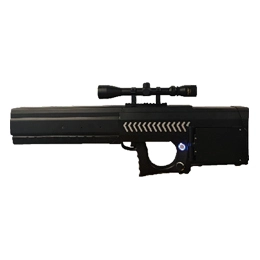
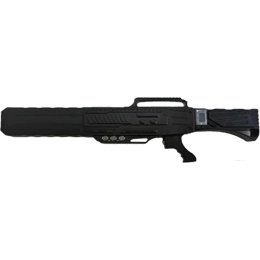
A handheld drone jammer gun is evaluated by security procurement teams as a portable drone jammer option within broader counter-UAS solutions because it aims to disrupt the radio frequency links that the drone depends on for control and navigation — potentially triggering fail-safe behaviors such as return-to-home or controlled landing — without kinetic engagement. Understanding what drives drone jammer gun price, how the technology works at a high level, and what legal framework governs its use is the foundation of a procurement decision that is both operationally effective and audit-ready in 2026.
Legal compliance notice: In the United States, intentional jamming of authorized radio communications — including GPS signals — is generally prohibited under federal law, and violations can result in severe civil and criminal penalties. This guide is intended for authorized government agencies, military organizations, correctional facility security teams, and entities operating in jurisdictions where the possession and use of RF countermeasure devices is legally permitted. Confirm your legal authority before any procurement or deployment planning.
The business case for counter-UAS investment is built on the measurable cost of drone-enabled incidents across three primary threat categories that have become operationally significant in 2026.
Unauthorized aerial imaging of industrial and commercial facilities provides adversaries with intelligence that previously required physical infiltration. A drone equipped with a zoom camera can document production line layouts, equipment configurations, shift change patterns, and access point locations from outside the facility's perimeter without triggering any ground-level security system. The footage can be used to identify security gaps, document proprietary processes, or support a targeted intrusion plan.
The business impact extends beyond the immediate information loss. Incident response — investigation, legal review, insurance notification, and regulatory reporting — generates direct costs that can reach tens of thousands of dollars for a single event. If the footage is published on social media or shared with competitors, the reputational damage and the cost of the subsequent security review compound the direct incident cost significantly.
Drone-based contraband delivery has become one of the most significant security challenges facing correctional facility administrators in 2026. Drones can deliver packages directly to exercise yards, rooftops, and window locations that are inaccessible to ground-level smuggling methods, bypassing the perimeter controls and visitor screening procedures that traditional contraband interdiction relies on. Mobile phones, drugs, weapons, and cutting tools delivered by drone enable criminal activity within the facility and create safety risks for staff and inmates.
A single confirmed contraband delivery event generates a facility lockdown, a search operation, an incident investigation, and a regulatory report — each of which consumes staff time and generates direct cost. The cumulative cost of repeated drone contraband events at a single facility can reach hundreds of thousands of dollars annually when staff overtime, investigation costs, and regulatory compliance costs are included.
Repeated unauthorized drone flights over a facility can generate a detailed three-dimensional model of the site — including building heights, roof access points, camera locations, and perimeter gap positions — that provides a comprehensive planning resource for a subsequent physical intrusion. This threat is particularly relevant for high-value logistics facilities, data centers, and critical infrastructure sites. The evidence chain implications of a documented mapping campaign — establishing that the facility was systematically surveyed before a subsequent intrusion — can significantly complicate the insurance and legal response to the intrusion event.
The correct response to these threats is not a panic purchase of anti-drone technology — it is a structured program that combines policy, technology, and documentation into a defensible counter-UAS solution that satisfies both the operational requirement and the compliance requirement.
A portable drone jammer operates by transmitting radio frequency energy on the bands that the target drone uses for its control link, video transmission link, and satellite navigation reception. The transmitted energy raises the noise floor on these bands at the drone's receiver, reducing the signal-to-noise ratio below the threshold required for reliable communication or navigation.
Control link disruption targets the radio frequency bands used by the drone's remote controller to send flight commands. Consumer and commercial drones most commonly use the 2.4 GHz and 5.8 GHz bands for their control links. When the control link is disrupted, the drone's flight controller detects the loss of communication with the operator and executes its programmed fail-safe behavior — typically returning to the home point, hovering in place, or initiating a controlled landing, depending on the drone's configuration.
Satellite navigation disruption targets the GNSS frequency bands — typically in the 1.5 GHz range for GPS L1 — that the drone's navigation system uses to determine its position. When the satellite navigation signal is disrupted, the drone loses its position reference and may execute a fail-safe behavior depending on its programming. The EXATIMES EXA-ZCFZ-001 model covers interference bands at 900 MHz, 1.5 GHz, 2.4 GHz, and 5.8 GHz simultaneously, providing multi-path disruption across the control, video, and navigation links that modern commercial drones depend on.
Video and telemetry link disruption removes the operator's situational awareness by blocking the live video feed from the drone to the ground station. Even if the drone's flight control is not immediately affected, an operator who loses the video feed may terminate the mission voluntarily.
The primary operational advantage of RF disruption over physical interception methods — nets, projectiles, or trained birds — is that it does not involve kinetic engagement with the drone. A drone that is physically intercepted may fall uncontrolled, creating a safety risk for personnel and property below. A drone whose control link is disrupted may execute a controlled return-to-home or landing sequence, reducing the risk of uncontrolled impact. This non-destructive characteristic makes RF disruption the preferred response concept for environments where uncontrolled drone falls would create safety or liability risks.
Drone jammer gun price varies significantly across the market — from a few hundred dollars for single-band devices with limited output power to tens of thousands of dollars for integrated detection-and-jamming systems with AI-assisted target identification. The EXATIMES EXA-ZCFZ-001 represents the integrated detection-and-strike category: a portable UAV detection and strike device that combines spectrum sensing, artificial intelligence, and radio interference technology in a single handheld platform.
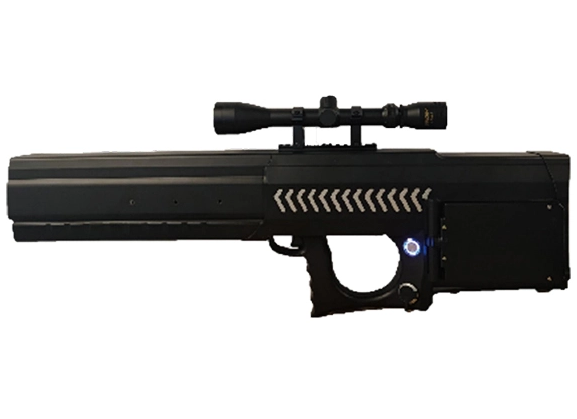
| Specification | EXA-ZCFZ-001 Value |
|---|---|
| Detection band | 2.4 GHz (2400–2485 MHz), 5.8 GHz (5150–5950 MHz) |
| Detection range | Greater than 1.5 km horizontal, 360° coverage |
| Detection response speed | Less than 6 seconds |
| Direction finding accuracy | Less than 20 degrees |
| False alarm rate | Equal to or less than 5% |
| Missing report rate | Equal to or less than 5% |
| Interference band | 900 MHz, 1.5 GHz, 2.4 GHz, 5.8 GHz |
| Interference distance | 1.5 km in open area |
| Interference power | 20W per single band |
| Operating temperature | -20°C to 50°C |
| Working hours on full charge | Greater than 8 hours |
| Protection class | IP54 |
| Equipment weight | 3.2 kg |
| Power supply | Built-in removable 28V/6000mAh battery; supports external USB power supply |
| Display | 5-inch touch screen, 800×480 resolution |
| Display content | Power display, UAV model and schematic, frequency band information, UAV signal strength, locking direction, detection diagram |
| Alarm mode | Sound, vibration, interface display |
| Detector type | Fixed wing aircraft, FPV, WiFi |
Band coverage is the primary price driver. A device that covers only 2.4 GHz and 5.8 GHz costs significantly less than a device that adds 900 MHz and 1.5 GHz GNSS coverage — but a device that covers only the two consumer bands will not disrupt drones that use other frequency bands for their control links. The EXA-ZCFZ-001's four-band interference coverage — 900 MHz, 1.5 GHz, 2.4 GHz, and 5.8 GHz — addresses a broader threat profile than two-band devices.
Integrated detection capability adds significant cost but also adds significant operational value. A device that combines detection — with direction finding accuracy of less than 20 degrees and detection response speed of less than 6 seconds — with interference capability in a single handheld platform eliminates the need for a separate detection system and reduces the operator's response time from detection to activation.
Battery runtime and power system design affect both cost and operational readiness. The EXA-ZCFZ-001's greater than 8 hours of working time on a full charge covers a full patrol shift without recharging, which is a significant operational advantage over devices with 2 to 3 hour runtimes that require mid-shift battery swaps.
Ruggedization and environmental protection — IP54 protection class and -20°C to 50°C operating temperature range — add cost but are essential for outdoor patrol use in variable weather conditions.
Before placing an order, confirm the legal authority to possess and operate the device in the jurisdiction of use. Request a written legal-use statement from the vendor, confirm the end-user eligibility process, and verify the export and import restrictions that apply to the specific model. In the United States, this step will typically determine that civilian operation of jamming devices is not legally permitted without federal authorization.
| Function Layer | EXA-ZCFZ-001 Capability | Operational Value |
|---|---|---|
| Detection | 2.4 GHz and 5.8 GHz spectrum sensing, 360° coverage, greater than 1.5 km range | Identifies drone presence and direction before activation decision |
| Direction finding | Less than 20 degree accuracy, less than 6 second response | Enables operator to orient the device toward the target |
| Alarm | Sound, vibration, and display alert | Notifies operator without requiring continuous screen monitoring |
| Interference | 900 MHz, 1.5 GHz, 2.4 GHz, 5.8 GHz simultaneous | Disrupts control, navigation, and video links across multiple drone types |
| Display | 5-inch touch screen with UAV model, signal strength, and direction diagram | Provides situational awareness during response |
| Endurance | Greater than 8 hours on full charge | Covers full patrol shift without recharging |
Correctional facilities face the most operationally urgent drone threat of any facility type — contraband delivery by drone directly undermines the security controls that the facility's entire operational model depends on. The response requirement is to stop the drone before it reaches the yard or the building perimeter, which requires a response capability that can be deployed quickly from a patrol position anywhere on the perimeter. A handheld counter-UAS device with integrated detection and direction finding — such as the EXA-ZCFZ-001 with its 360-degree detection coverage and less than 6 second response speed — provides this rapid-response capability without requiring fixed infrastructure installation.
Industrial and logistics parks face aerial espionage and inventory surveillance threats from competitors, organized theft groups, and activists. The threat is typically lower urgency than the correctional facility contraband threat, but the cumulative intelligence value of repeated overflights can be significant. A counter-UAS program at an industrial facility typically combines a detection system that provides early warning of drone activity with a handheld response capability that can be deployed to the relevant perimeter sector when a drone is detected.
Power generation facilities, substations, and pipeline infrastructure face unauthorized overflight threats that combine espionage risk with the potential for deliberate disruption. The regulatory environment for critical infrastructure security is increasingly requiring documented counter-UAS capability as part of the facility's security plan — which means that the procurement of counter-UAS equipment must be accompanied by documented policies, training records, and incident reporting procedures.
Public venues and VIP events face drone threats that combine privacy risk with crowd safety risk from uncontrolled drone falls. The counter-UAS response at a public venue must be carefully managed to avoid disrupting legitimate drone operations and to minimize the risk of uncontrolled drone falls over the crowd. A layered approach — detection and identification first, followed by authorized RF disruption only for confirmed unauthorized drones — is the appropriate response model for this environment.
Step one: define the threat outcomes to prevent and the required response time. Identify whether the primary threat is contraband delivery, aerial espionage, illegal mapping, or a combination, and define the maximum acceptable time from drone detection to mission disruption. This time requirement determines whether an integrated detection-and-interference device — which eliminates the handoff delay between a separate detection system and a separate response device — is required.
Step two: confirm legal authority. Before any other specification work is done, confirm the legal authority to possess and operate RF countermeasure devices in the jurisdiction of use. In the United States, this step will typically determine that civilian operation of jamming devices is not legally permitted without federal authorization.
Step three: specify the required band coverage based on the drone types observed at the facility. A facility that has observed consumer DJI drones in contraband delivery incidents may be adequately served by 2.4 GHz, 5.8 GHz, and GNSS coverage. A facility that faces a broader threat profile — including modified commercial drones with non-standard control links — may require additional band coverage including 900 MHz.
Step four: define the operational constraints. Confirm the patrol duration and whether the battery runtime covers the full shift without recharging. Define the training requirement for operators, the escalation rules that govern when the device may be activated, and the recordkeeping requirements for each activation event.
Step five: define the acceptance criteria. Specify the vendor support terms, warranty period, maintenance plan, and compliance documentation that the procurement requires.
| Cost Item | Without Counter-UAS Program | With Integrated Handheld Counter-UAS Program |
|---|---|---|
| Contraband incident response cost | High — lockdown, investigation, staff overtime, regulatory report | Lower — faster response reduces incident escalation and investigation scope |
| Aerial espionage incident cost | High — legal review, security review, reputational damage | Lower — mission disruption before footage is captured |
| Guard hours per drone incident | Higher — extended response and investigation time | Lower — integrated detection reduces time from alert to response |
| Battery replacement | Not applicable | Periodic replacement based on charge cycle count |
| Antenna and housing inspection | Not applicable | Periodic visual inspection and functional test |
| Training and policy documentation | Not applicable | Initial training and annual refresher; activation log for audit |
Battery health management is the primary maintenance requirement. The EXA-ZCFZ-001's built-in removable 28V/6000mAh battery should be tracked by charge cycle count rather than calendar time — battery capacity degrades with cycles, and a replacement schedule based on cycle count ensures that the device maintains its rated greater than 8 hour runtime throughout the program. Maintaining a spare battery inventory that covers the patrol duration without recharging provides operational continuity during battery replacement cycles.
In 2026, the drone threat to facilities is a current operational reality that is generating measurable costs in contraband incidents, aerial espionage events, and illegal mapping operations. A handheld drone jammer gun that integrates detection, direction finding, and multi-band RF interference in a single platform — such as the EXATIMES EXA-ZCFZ-001 with its four-band interference coverage, greater than 1.5 km detection range, less than 6 second response speed, and greater than 8 hour battery runtime — provides the rapid-response, non-destructive counter-UAS capability that facilities need to stop the mission before it is completed.
The specifications that determine drone jammer gun price — band coverage, integrated detection capability, output power, battery runtime, and ruggedization — must be evaluated against the specific threat profile and operational requirements of the facility. And the legal authority to possess and operate the device must be confirmed before procurement, because a counter-UAS program that is not legally authorized is a liability rather than a security asset.
Visit the drone jammer gun product page to review the full range, then submit the following details to receive a matched configuration and quotation:
| Parameter | What to Provide |
|---|---|
| Work condition | Facility type (prison, warehouse, energy, event), outdoor area size, RF environment (dense Wi-Fi or cellular), country and state of use, compliance requirements |
| Quantity | Units needed, number of patrol shifts, spare batteries and spares plan |
| Size and spec | Required band coverage (GNSS, 2.4 GHz, 5.8 GHz, 900 MHz, or other), target runtime, weight and ergonomic constraints |
| Target metrics | Response readiness time, coverage objective, documentation and audit requirements |
| Current problem | Recurring overflights, contraband drops, unauthorized filming, mapping incidents, high incident response cost |
 English